The United States has a long tradition of photographing presidents with their cabinets on the eve of war or military escalation. FDR at his desk, surrounded by his ministers on 8 December 1941, the day after Pearl Harbour; Lyndon Johnson with his foreign policy advisors in the Oval Office on 27 July 1965, weighing up whether to increase troop numbers from 75,000 to 125,000; George W Bush and his cabinet on 19 March, 2003, the day before military operations began against Iraq - all these pictures are part of the historical record, aimed at future generations.
At the same time, the photographic record is often intended to convey a certain image of American power to the present: in which decisions of national security and war and peace are taken through careful deliberation and consensus by wise, thoughtful officials with knowledge, experience and expertise. Often there is a uniformed general around to bolster the impression of competence and consultation. None of this applies to the photos released by the White House that accompanied the US-Israeli strikes against Iran on 28 February.
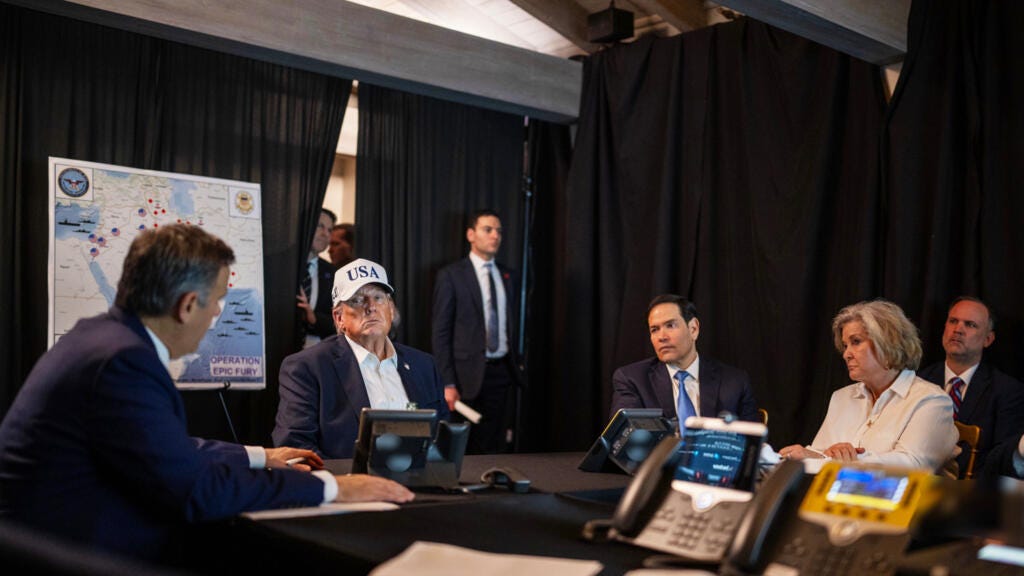
These photos were not taken in the White House, but in a curtained-off ‘situation room’ in Mar-a-Lago, presumably so that Trump could fit in the meetings between rounds of golf. The setting looks as improvised and provisional as the war itself. One of the photos shows Trump, Marco Rubio, chief of staff Susie Wiles and CIA director John Radcliffe sitting round a table. Behind them, a large map of the Middle East marked Operation Epic Fury that looks like a Risk board is festooned with battleship markers and diamond-shaped targets in Iran.
Trump is wearing a USA baseball cap, and looks like a cobra struggling to stay awake while sucking on its own venom. His advisors - assuming that’s what they were doing - seem simultaneously resigned, blank, and entirely nonplussed. Through the gap in the curtain, you can see the gilded trashiness of Trump’s pleasure dome - the same building where the FBI found thousands of top secret classified documents in 2020.
There is not the faintest trace of competence, knowledge or expertise in this grim ramshackle tableau. This is an image of indolence, craven submission and fundamental unseriousness, all of which makes it the perfect historical marker of a war unleashed on impulse and capriciousness, with a barely-disguised yawn, by men and women without the slightest concern for its consequences.
It is likely that posterity will regard this photograph as a terrifying reminder of how the most powerful country in the world abased itself before the dim-witted, malignant, maggot-brained creature who now commands the most destructive military machine in human history.
The decision to go to war is always the most serious decision a government can take, and there are times - at least to those who are not pacifists - when war is necessary. But the horrific conflict now unfolding is not one of them. This was a war of choice, and wars of choice are always wars of aggression. Indeed the prevention of such wars is one of the primary aims of the ‘international rules-based order’ constructed in the aftermath of World War II.
It was for this reason that the 1945 Nuremberg International Military Tribunal designated the plotting and waging of aggressive war as the ‘supreme international crime’ which ‘contains within itself the accumulated evil of the whole.’ It’s why the United Nations includes ‘the prevention and removal of threats to the peace, and for the suppression of acts of aggression or other breaches of the peace’ in its foundational charter. It’s why the 1974 General Assembly Resolution XXIX defined wars of aggression as a ‘crime against international peace.’
Of course, there have been many breaches of these principles, and powerful countries - not least the United States - have found ways to circumvent them. But no government since World War II has ignored them with the brazen contempt and disdain that the Trump administration has shown, in the ludicrous and vaingloriously-named Operation Epic Fury.
Few governments in the history of human conflict have ever waged war with so little understanding of the enemy they are fighting, and with such a complete absence of any coherent strategic vision, beyond the performative display of destructive military power that Trump and his equally-depraved minions regard as strength.
The Stupid War
This is a war that Israel has wanted to fight for decades, and which it has been repeatedly trying to drag the American colossus into. It’s the war that American neocons once dreamed of, when the slogan ‘real men go to Tehran’ accompanied the build up to the invasion of Iraq. It’s a war that has its roots in Trump’s 2018 decision to wreck the nuclear agreement achieved under Obama, and impose sanctions on Iran.
Now Israel has its wish, and America is once again at war, led by a fascistic administration that you would not trust to run a crack den, and whose members act as if they have just stumbled out of one. In the final scene of Scarface, a coked-up Tony Montana staggers out of his Florida mansion, with an M16-turned grenade launcher, zonked on his own stash.
At least Montana was fighting for his life. The same cannot be said of the vicious clowns who inflicted this calamity on the world from another Florida mansion, for no good reason whatsoever. In doing so, they have unleashed a cascade of killing and destruction that threatens to destabilise the Middle East once again, and deal a final blow to the withered carcass of rules, treaties and obligations that the architects of the post-World War II international order constructed to prevent precisely this kind of outcome.
In The Godfather - the gangster references write themselves with this shower of bastards - Michael Corleone attends his nephew’s baptism, while his hitmen massacre the rival Barzini and the Tataglia families, who the Corleones had lured into a negotiated peace. The Witkoff/Kushner team played the same game with the Iranians who they were pretending to negotiate with. Only the day before the strikes, the Omani Foreign Minister Badr Albusadi reported that negotiators had made ‘substantial progress’, and that Iran had agreed to blend its supplies of enriched uranium to the ‘lowest level possible.’
Contrary to the lies that have been told since, it was probably for precisely this reason that Israel and the US launched the strikes 24 hours later that killed Iran’s Supreme Leader Ayatollah Ali Khameini and begun bombing Tehran. In a single stroke, Trump wiped out hundreds of years of diplomatic practice, whilst also violating international customary law prohibiting the killing of heads of state.
Such actions are also a breach of US federal law, not that Trump cares. Executive Order 12333 - enacted in the wake of the Church Committee’s investigations into the CIA’s covert ops and signed by Ronald Reagan in 1981, expressly prohibits US personnel from engaging in or colluding in the assassination of foreign leaders.
You may not like Khameini or the regime he headed - I certainly don’t - but assassination is the stuff of political nightmares. It ushers in a world in which any country can decide to kill any leader it wants. But Trump has done this because he sits at the helm of the one country on the planet that looks at every other country - and certain countries in particular - through a gunsight or a bombsight.
So when the White House posts gleeful Call of Duty-style videos of missile strikes on Iran, and gleeful TikTok reels alternating crude Hollywood-mashups with real attacks, it is not just demonstrating the depravity of its current occupants. In presenting carnage and death as entertainment, these videos also reflect how America views much of the world - in which certain countries are bombable targets.
Subscribe now
It makes no difference who its leaders are. They might be Harry Truman, Kennedy, McNamara and the ‘brightest and the best.’ Or Ronald Reagan sending Contras to slaughter teachers or shooting up harbours in Nicaragua with an ‘aw shucks’ folksy grin. It could be George Bush warning that the smoking gun cannot become a mushroom before blitzing Iraq. Or Barack ‘I’m really good at killing people’ signing off Predator drone ‘double tap’ strikes in Waziristan. America is always locked and loaded, and very few presidents can resist the urge to pull the trigger.
Sooner or later, every American leader follows the pattern defined by the sinister neocon spook Michael Ledeen in 1992 that: ‘Every 10 years or so, the United States needs to pick up some small crappy little country and throw it against the wall, just to show the world we mean business.’
Now the Trump gangsters are applying this rule to a ‘crappy’ country of 93 million people for no good reason whatsoever. We know why Israel wants this war. Unconstrained and by its devastation of Gaza, by a succession of tactical victories, and by the carte blanche it has received from successive American administrations and the ‘international community’, the Netanyahu government believes that it can eliminate Iran as a military threat and transform it into a failed state.
Some commentators have worried likely that Iran might slip into chaos and civil war as a result of this assault. It is highly likely that Israel is seeking precisely this outcome. Because if Iran follows Iraq and Syria, then Israeli military domination of the Middle East will be entirely unopposed, and Israel will be free to complete its destruction of the Palestinian people, annex the West Bank, and expand its borders into Syria and Lebanon.
The motivation of the Trump mafia is less clear. The administration does not even seem to know itself why it has done this. It has not tried to explain its motives or aims to Congress, as the Constitution requires. Instead, succession Trump and his lackeys have given a series of half-baked, implausible and downright dishonest statements to the media, which frequently contradict each other.
Before the strikes began, Trump’s disreputable envoy Steve Witkoff claimed that Iran was only a ‘week away’ from acquiring material to make a bomb. Then Trump himself - borrowing a leaf from George Bush’s playbook - claimed that Iran had restarted its nuclear program and was developing missiles that could ‘threaten our very good friends and allies in Europe’ and would soon be able to ‘reach the American homeland.’
Trump then called on the Iranian people to rise up against their own government, suggesting that regime change was the goal. But little more than a day later, Pete Hegseth - the Secretary of War who makes Conan the Barbarian sound like Bertrand Russell, claimed that regime change was not the goal, though the regime had to change.
Don’t try to figure this out, because Trump then claimed -falsely - that the US was in talks with Iran, and that he would be willing to accept a Venezuela-style arrangement with a new Iranian government, suggesting that popular uprisings and regime change might not be the goal, after all.
Meanwhile, his dead-eyed hapless consigliere Marco Rubio told reporters that the US had decided to strike Iran because it knew that Israel was going to do so, and that US forces would therefore be attacked, and so it decided to strike first. Could the world’s only military superpower not have have stopped Israel from carrying out its attack? Shouldn’t the US have taken steps to protect its bases - not to mention American citizens who were in the line of fire?
None of this happened, and Trump then contradicted Rubio and said that, on the contrary, he had ordered the strikes, and Israel had followed his lead . And his propagandist-in-chief, Comical Karoline Leavitt then claimed that Trump had gone to war ‘on a feeling based on fact.’
What was this ‘fact’? That Iran poses ‘an imminent and direct threat to the United States of America’ - another whopping lie dismissed by most experts, but which will be entirely familiar to anyone who remembers the Iraq war.
All this suggests that this is a war in search of a meaning, or that simply acquires meanings makes it up as it goes along. It may indeed be that this war was intended to knock the Epstein Files off the front pages, in which case it has succeeded. And even though most Americans do not support it, and Trump started it without Congressional approval, wars can easily create an internal dynamic of crisis and emergency that a docile opposition will readily succumb to, and that can give a government all sorts of emergency powers that it didn’t have before.
Whatever its reasons for starting the war, it is not at all clear if the US knows how to finish it. Does the US intend to dismember Iran, by inciting separatist rebellions and civil war? Or does it seek to control its central government, the way it has sought to control Venezuela?
US talks with Kurdish forces in Iraq suggest that the former may be an option. But Trump’s megalomaniacal insistence that he must be allowed to choose Iran’s leader suggests that he wants to rule Iran by proxy through a central government approved and appointed by the US That statement is one more indication of how little Trump and his minions understand Iranian history or the kind of regime they are dealing with.
Last week, Trump’s brutish Secretary of War denounced ‘Crazy regimes like Iran, hellbent on prophetic Islamist delusions’. This image of a country hellbent on collective martyrdom has been so widely disseminated that it has almost become established fact in Washington and other Western capitals. But the Islamic Republic is no crazier than the government currently running the United States. Its leaders are as capable of taking geopolitical decisions in what they perceive as the national interest - and their own - as any other country, which doesn’t necessarily mean that these decisions are good ones.
Trump and his minions seemed to have assumed that the Islamic Republic would fold after killing its figurehead. Instead, Iran has unleashed multiple attacks on US bases and allies that has dragged 14 countries so far into the theatre of war.
These capabilities have clearly been developed over some years, in preparation for an event like this. Iran cannot match Israel or the United States in terms of conventional firepower, but it can force the US to disperse its forces; it can increase the political and economic cost of the war both regionally and internationally. It can drag the war out, testing the will of its enemies and their domestic constituencies.
Iran’s strategy of attacking almost all its neighbours may backfire, but this is a regime that is fighting for its survival, and in such circumstances, mistakes can and will be made - particularly when Israel and the United States are killing leaders who might have been able to curb the regime’s worst instincts. Iran apologised to neighbouring states yesterday and promised to limit its attacks to countries from which it was attacked, suggesting that its leadership has exerted some control over its military leaders.
In the case of the United States and Israel, no one is curbing anyone, as Trump and his officials revel in killing, death and destruction, like psychotic boys pulling the wings of flies. Every day, Trump, Hegseth, Miller and their fascistic supporters exult in a war unconstrained by what Hegseth called ‘stupid rules of engagement’.
Reacting to news that more than 165 Iranian schoolgirls had been killed in a ‘double tap’ strike on a primary school, conservative lobbyist Matt Schlapp told Piers Morgan, these girls are better off dead than being ‘alive in a burqa.’ Hegseth bragged that a US submarine had torpedoed an unarmed Iranian frigate sailing home naval exercises with the Indian nary, killing more than 60 men in what he called a ‘silent death’. Dozens of others were left to drown, and would have drowned, had the Sri Lankan navy not rescued them.
Last Sunday, a US or Israeli ‘double tap’ strike hit Tehran’s Niloofar Square. A witness interviewed by Dropsite News described what happened:
One hit and it wasn’t that bad but when the second one hit, suddenly everything exploded. The windows all shattered. Whoever had hookahs were thrown to the floor…One of my friends whom I don’t know that well he was sitting here. His hookah was in his hands until the last moment. He was severed in half. Half of him was thrown to the side. I put him back together and placed him where he was. A piece of his brain was thrown here on the floor.
This is gangster-imperialism in practice. This is one more reason why Operation Epic Fury should be called Operation Epic Depravity: a rampant display of lawless violence, unconstrained by any humanitarian or legalistic considerations or any pretensions to nation building and democracy building.
It’s a war in which fundamentalist Christian officers are telling their soldiers that Trump was ‘anointed by Jesus’ to bring about Armageddon in the Middle East and bring back the Messiah; in which six anonymous gamblers can make $1.2 million betting on the bombardment of Iran on the cryptocurrency prediction site Polymarket - to which Donald Trump Junior is an investor and advisor; in which the freakish ghoul Melania Trump can chair a United Nations Security Council meeting on ‘children in conflict’ only days after her husband’s war has massacred Iranian children in an elementary school.
All this could not be more dystopian, dangerous or disgusting. Thousands of Iranians have been killed and wounded. Tehran’s oil refineries are now burning. Israel has attacked a desalination plant and Iran has responded in kind in Bahrain. It now seems that Gaza, rather than a savage aberration, has become a model for both Israel and the United States.
It is painful and horrific to watch such carnage unfold. It is a legal and moral obscenity that the United States and its bloodthirsty sidekick should be able to bomb cities with impunity and displace tens of thousands of people, dragging the region and the world into a new era of lawless brute force. And yet all this has been done with very little opposition or condemnation from the upholders of the ‘rules-based order.’
The House of Cards
No one can be at all surprised that rightwing ‘populist’ leaders across the world, from Milei, to Farage, and Abascal have loudly approved of the war. These are little men who will always wade happily through any political sewers, and who will approve of anything Trump does, because they think it will benefit them. Nor can anyone be surprised to find the likes of Boris Johnson, Andrew Neil or Stephen Pollard applauding the American-Israeli assault as if were some kind of righteous crusade.
Surprisingly, there have been some criticisms of the war from unlikely sources within MAGA itself. But the general response from the ‘international community’ has been silent or muted. This silence has been particularly striking amongst some of the defenders of the ‘rules-based order’. If the notion of international ‘order’ means anything, it must surely be related to the ability to prevent and condemn aggressive war, regardless of the perpetrator.
Yet barely had the strikes begun last weekend than Mark Carney - the eloquent defender of that order at Davos - declared Canada’s ‘full support’ for the US-Israeli assault, in order to ‘prevent Iran from obtaining a nuclear weapon’ - regardless of the lack of evidence to suggest that Iran had any such intention or capability.
Carney later rowed back slightly, claiming that he only supported the strikes ‘with regret’ because ‘the current conflict is another example of the failure of the international order.’
Russia and China were more forthright in condemning the strikes as a ‘cynical violation of law’, and called for an immediate halt to military operations. But Russia is not the country to pontificate on such matters. The Brazilian government also condemned the attacks and pointed out they ‘occurred amid a negotiation process between the parties.’
The European Union did not support the strikes, but its response to them has been weak and subdued. European commission President Ursula von der Leyen and European Council President Antonio Costa called the conflict ‘greatly concerning’ and exhorted all parties to ‘exercise maximum restraint’ to protect to civilians, and to fully respect international law’ - regardless of the fact that the US-Israeli assault was as much a breach of international law as the Russian invasion of Ukraine.
In an initial joint statement, the UK, Germany and France condemned ‘Iranian attacks in the region in the strongest terms’ and called on Iran to ‘refrain from indiscriminate military strikes’ and resume negotiations. There was no mention of the US-Israeli strikes that had brought these negotiations to an end.
In a visit to the White House last Tuesday, the German Chancellor Friedrich Merz shamefully told Trump that Germany was ‘on the same page in terms of getting this terrible regime in Iran away, and we will talk about the day after,’ while also allowing German bases to be used to carry out further attacks.
Not surprisingly, this abasement pleased the orange emperor, who called Merz an ‘excellent leader.’ Trump was less pleased with Keir Starmer, who was as cautious and timid as we have come to expect him to be on almost everything. Such caution might seem welcome, in comparison with the mindless gung ho calls from the likes of Badenoch and Farage, for the UK to join offensive operations. But this is a low bar, and it doesn’t take much to rise above it.
Some commentators have cited Starmer’s refusal to allow US planes to use British bases as an indication of his skilful diplomatic tightrope walking, but a cabinet meeting leak suggests that Starmer would have allowed these bases to be used, had it not been for opposition from his own ministers. Instead, he reached a compromise: that British bases can be used for ‘defensive’ purposes by taking out Iranian missile silos. Leaving aside the question of how these distinctions would actually be monitored, the notion of ‘defensive’ strikes is objectively meaningless in an illegal war in which every US bomb or missile has an offensive purpose.
Even this sleight-of-hand could not pacify the rabidly rightwing British press, nor did it satisfy Trump. It is also unlikely to be permanent. Though Starmer has insisted that he would not join a war without a ‘lawful basis’, he has not explicitly not ruled out the possibility that Britain may join in the US-Israeli assault in future. Given that Starmer responded to last Israel’s attacks on Iran last year by immediately offering the RAF to ‘defend Israel’, no one should assume that his ‘standoff’ with Trump will last long.
This is how international ‘order’ collapses - not just when powerful countries break the rules, but because the countries that proclaim to represent these rules do not condemn or oppose those who break them, or do so only selectively. Amid this timidity and discount store realpolitik, only the Spanish president Pedro Sánchez has denounced the perpetrators with the outrage they deserve, declaring unequivocally:
Spain’s position is the same as in Ukraine or Gaza. No to the breakdown of international law that protects us all. No to resolving conflicts with bombs. No to war
Sánchez is no less politically vulnerable than Starmer or Macron. Like Labour, his government is fragile, and he faces a conservative-far right bloc without decency or scruples that is looking for any opportunity to destroy him. Yet he refused to allow the US to use Spanish bases, and made arguments that shame Trump’s would-be appeasers:
Some will say that this is naive. What is naive is to think that violence is the solution. Or to think that blind and servile obedience is leadership. We are not going to be complicit in something that is bad for the world for fear of reprisals from someone
Exactly that. And Sánchez has even managed to coax some lukewarm gestures of solidarity from Macron and von der Leyen, in addition to some mild criticisms of the illegality of the war. But as the European Council on Foreign Relations argues, this is not enough. Even from the point of its own interests, the European Union needs to defend Spain against Trump’s threats and distance itself from a deranged war that may well usher in the defeat of Ukraine.
We cannot have a world in which the United States is able invade and bomb any country it likes without opposition or condemnation, merely because it is powerful. We cannot have a Middle East in which Israel is allowed to destroy and devastate its neighbours, with complete impunity.
There is no way that a better Middle East and a better world will come out of this. It is more likely that it will be made much worse. And to those who say that Iran cannot be allowed to have a nuclear bomb, the US-Israeli war of aggression has just given every country in the region the best possible reason to acquire one.
We need leaders who will call, loudly, clearly and without any equivocation, for the strikes to cease, who will uphold the authority of the United Nations that Trump and Netanyahu are trampling on, and stand up for the values that supposedly uphold the European Union ‘peace project.’ With the exception of Sánchez, we don’t have them. Instead we have only silence, cowardice and collusion with the violent American Behemoth, a narrow focus on the national interest, and the occasional polite tepid criticism.
Tragically, this is not entirely surprising. Too many governments had already found a way to live with genocide in Gaza. Just as they emphasized with the ‘suffering’ of Palestinians while nothing to prevent that suffering, they may well find a way to support or at least acquiesce in Trump’s war of stupid, with the usual headshaking pieties about sparing civilians.
This weakness and de facto obeisance is almost as dismaying as the brazen gangsterism that we are now witnessing. In the aftermath of World War I, William Butler Yeats famously wrote ‘the blood-dimmed tide is loosed/and everywhere the ceremony of innocence is drowned/The best lack all conviction, while the worst/ Are full of passionate intensity.’
Those words could almost have been written for our own perilous times, as ‘mere anarchy is loosed upon the world’ by some of the worst examples of humanity this planet currently has to offer, with the tacit complicity of leaders who believe themselves to the best, or at least better, but too often lack the courage of their convictions.
Perhaps they never really had any to begin with. Or perhaps they have also been looking at certain countries through a gunsight for so long that they no longer care who pulls the trigger, or how many people are killed, or how many cities are bombed and destroyed by the gangsters who have just set the world on fire for no good reason.
Share
 Log in