Brit living in Belgium and earning an income from building interfaces. Interestes include science, science fiction, technology, and European news and politics
Elena Rossini (rightly) calls shenanigans on what’s been happening in the European social world. I think what happened should be instructive for any pro-social technology movement.
Eurosky, a non-profit fork of Bluesky that is both fully open source and stores all its data in the EU, subsequently launched Mu, a social media application running on AT Protocol that is fully EU-based and is arguably more fully-featured than Bluesky itself.
But the European Commission, including its President and its Central Bank’s President, went another way by migrating to W Social, a proprietary AT Protocol. Whereas Eurosky is a non-profit that has worked extensively in the open with open social web and democratic communities, W Social is a for-profit startup that has been opaque about its intentions and, as Elena now reports, has now pulled its code from being available on an open source basis. These EC profiles now live on a platform that contradicts the EC’s own sovereignty plan.
So I strongly agree with Elena’s implication that the Commission made a poor decision here. But it happened because its founders are heavily connected: it launched at the World Economic Forum in Davos, and its advisors include politicians from across Europe.
Ten years ago I joined a top 100 website after working in open source social for a decade. Based on my naïve experience in open circles, I’d assumed it competed on having a great product. In fact, it hired well-connected partnerships people, already known to influential decision-makers, who worked tirelessly behind the scenes. That team included the relatives of Presidential hopefuls and people who had built wildly successful careers as media executives. Having a good product was table stakes at best; being successful meant negotiating politics, making quid-pro-quo deals, and convincing people to join by any means necessary.
W Social is the insider’s tool: a platform created people who know how to work the system for their own benefit. That ultimately means it’s more likely to betray its users. It seems likely to me that when the discourse moves away from sovereignty to something else, the founders will also shift. But it’s not a surprise to me that European politicians are more likely to work with a platform that partners with and pays people they already know.
The nice thing about open platforms is that there doesn’t need to be one winner. The European Commission has made a bad decision, but Eurosky can still find everyone else. By building better tools for the writers, the artists, the culture-makers, and onboarding people through careful outreach one community at a time, it can serve as the basis for a new social commons that is free from US influence. I hope it succeeds.
Emily Darlington is Labour MP for Milton Keynes Central and a member of the Science, Innovation and Technology Committee.
LONDON — I’m a mum. I know a social media ban won’t make my kids safe. It will put them at more risk.
For the last two years I’ve held tech companies to account on the Science, Innovation and Technology select committee. I’ve met with representatives from every big social media platform and challenged them on the features that are putting young people in danger and damaging their mental and physical health to extents we don’t yet understand.
I want kids to be safe online. But I do not believe that an Australia-style outright ban is the solution. If this government implements a simplistic last-ditch effort, I believe it will backfire once parents see this policy for what it is: A cop-out from making difficult but necessary changes that will actually work.
Three quarters of Australian teens are already back on social media since the “ban.” They’re either on it without their parents’ knowledge, taking away one of the strongest protections kids have against predators, their parents; or they’re on smaller, more dangerous platforms that aren’t big enough to come within the scope of a ban.
That list includes Tattle.Life, the gossip website that has claimed several lives; Telegram, where communications can’t be traced, or the so-called Incel Forum, where a post mentioning rape is added every 29 minutes, and nine out of 10 posters in those discussions support sexual violence against women. Australia’s model excluded all of these platforms alongside gaming platforms like Roblox, which are social by design and allow strangers to talk directly to kids with no guardrails.
A smartphone displays social media app logos on Dec. 31, 2024. | Anna Barclay/Getty Images
Platforms like Facebook and Instagram need to be regulated to be safe for kids — but I know how to use them, and so can talk to my kids about how to stay safe on them and I can supervise their use if I feel I need to. But if they are banned, I won’t know what kinds of websites and forums their schoolmates join and could encourage them to join as well. And neither will the government, at least not before a terrible headline appears that sheds a light on what our kids are doing in the dark corners of the internet now that we’ve banned them from the spaces we can see.
A ban does nothing to stop new platforms cropping up quicker than government can identify them, let alone legislate against them. A platform-based ban risks creating a never-ending game of whack-a-mole, where we chase yesterday’s technology while today’s alternatives are left to flourish unchecked.
The problem is not social media platforms themselves. It’s the features and business models that make them unsafe for children and young people.
An age ban lets social media platforms off the hook far too easily. They’ve been left unregulated for far too long, making money off exploitative and dangerous features that put all users at risk. What makes a 17-year-old girl less vulnerable to grooming by a stranger than a 15-year-old? Shouldn’t we ban the ability of strangers to contact young people, instead of allowing them to prey on newly turned 16-year-olds who have no experience spotting their tactics?
These are the kinds of specific functionalities we must focus on if we want social media ever to be a safe place for anyone, including young people. Endless algorithmic feeds designed to keep you online for hours, AI chatbots that encourage suicide and self-harm, direct messaging from strangers, and recommendation engines that rapidly push harmful content — these are the real issues.
A platform may disappear, but these features can and will simply reappear elsewhere. Teens will be moved onto the kinds of niche web forums that have historically been the home of the most extreme harmful content. They will use new, untested platforms in secret, exposed to the sorts of exploitation and predatory behaviour that is already banned on mainstream social media platforms. And more worryingly, if using social media is a prohibited activity, a young person who is being cyberbullied, blackmailed, harassed, or stalked online will be even more reluctant than they already are to tell a parent or teacher, for fear of getting into trouble themselves.
If this does happen — and the evidence from Australia shows it will — what will this government say to the parents it promised that a ban would protect their kids? When the headlines prove we were wrong, what leverage will we have over social media accounts whose business models have already changed to exclude young people, to ask them to please make it safe for them to come back online?
The choice is not between doing nothing or banning social media altogether. It’s between regulating brands and regulating harms. One approach will leave legislators perpetually playing catch-up. The other has a chance of making the internet genuinely safer for children. Banning platforms may generate headlines, but making platforms safe would actually solve the problem.
The Ukraine and Iran wars are very different, but a common authoritarian delusion unites the men who started them
A strongman president, self-styled redeemer of national glory, is trapped in a conflict he can’t win but doesn’t know how to end without looking like a loser. A cult of infallibility prevents the leader admitting a strategic blunder even to himself. It could be Donald Trump or Vladimir Putin; Iran or Ukraine.
The conflicts and the regimes involved are also dissimilar in important ways. Russia’s campaign to eradicate a neighbouring democracy is nastier in conception and bloodier in execution than the bungled US effort to dislodge a dictatorship in Tehran. It has also gone on much longer. The first world war was shorter than a “special military operation” that was supposed to capture Kyiv within weeks. The Soviet Red Army repelled Nazi invasion and marched on Berlin in less time than it has taken Putin’s forces to occupy a tranche of eastern Ukraine, and they are not making any significant advances. The war has burned trillions of roubles and sacrificed hundreds of thousands of lives for no discernible dividend in national greatness.
Sharon Farmer, Public domain, via Wikimedia Commons
This week offered us a tour inside of Tony Blair’s skull. Ostensibly, it was all about Net Zero and AI and the left of the Labour party and all that. But in reality it was about the state of his mind.
Blair was one of the best prime ministers we ever had. He was wrong on Iraq and wrong on civil liberties. He was wrong on any number of things which are less commonly mentioned, like the rhetoric around asylum seekers or PFI contracts. But he was an outstanding communicator and he delivered real results while managing to keep together an extremely broad political coalition. Last week’s piece on combining vision with policy and delivery could almost have been written about him. In a very real sense, he provided the modern template for how to do the job well.
He is also one of the worst former prime ministers we have ever had.
This is a really specific and useful role, which is underrecognised. It provides a space for someone with experience and gravitas to intervene in political life. If you get it right, you can be an elder statesman, providing continuity with the past, an articulation of national values, and an assessment of the future.
Blair is atrocious at this role. Within seconds of leaving No.10, he fixated on accreting personal wealth: an advisory role at JPMorgan Chase and Zurich Financial Services, exorbitantly-priced private speaking gigs, contracts with human rights abusers. That tendency led naturally to his current situation, with the Tony Blair Institute taken over wholesale by billionaire Larry Ellison so he can use Blair as a ventriloquist dummy for his views on AI. Everyone has a price. It turns out Blair’s price was $130 million for the 2021-2023 period, and $218 million since then.
With that kind of record, there was never any chance that people would be able to take Blair’s statements seriously. At best, they were interruptions to his commercial ventures and at worst cynical mechanisms to advance them.
But the most severe problem was not financial. It was psychological. His comments were not motivated by the state of the world. They were motivated by an attempt to validate himself and the decisions he took in office.
Blair’s 5,700 word essay this week saw commentators enter into ever-more elaborate calculations about his intentions. On the face of it, they were hard to discern. Exactly what was the purpose of all this?
He didn’t seem to be supporting anyone, it was just a scattershot attack on whoever he laid eyes on: Keir Starmer, Wes Streeting, Andy Burnham. Some people suggested he wanted to trigger a policy discussion in the Labour party. Laughable. His policy prescriptions were banal, rudimentary and utterly devoid of content. At one point, the efforts to uncover a motivation became so absurd that commentators suggested the whole essay was a ruse by Streeting, who is considered a Blairite, to be attacked from the Labour right and therefore portray himself as more left-wing. Preposterous fantasy.
The real reason Blair wrote that piece is because he needs to self-validate. The lines about the present day are not about the present day at all. They are implicit defenses of the decisions he took in office. The purpose of the essay is to demonstrate that he was right about everything.
In truth, he simply has no contact with modern British political life. On issue after issue, he seemed utterly ignorant of the present reality. “It is one thing when in opposition to indulge this perennial delusion that when we lose seats to the right the country is really signalling it wants Labour to move left,” he wrote. “It is dangerous to do it in government.”
Is there anyone else who does not know that Labour is losing votes on the left to the Greens? I don’t want to get into the question of precisely how many compared to Reform. I mean on the really basic level which literally everyone accepts and is aware of, which is that many Labour votes are going to the Greens. Blair seems blissfully unaware of this, or uninterested in it. He is still fighting the old electoral battle in which you could bank on loyal Labour voters and loyal Tory voters and the election would be won by winning over the small number of swing voters in marginal seats between them.
This is the case on issue after issue: properly embarrassing rudimentary errors on statements of fact. And the reason for these errors is that he is not actually talking about the modern world. He is talking about the early 2000s. The essay was a justification. It defended his general approach to political strategy. It defended his hazy conception of the ‘radical centre’, which he has been trying to define for three decades now to no avail. And, of course, like nearly everything he has done since 2003, it defended the decision to invade Iraq, through its resolute view that Britain must stand by America no matter what she does, even if she is led by a psychopathic fascist gorilla.
We learned nothing about the world, or the Labour party, or the leadership candidates, or any particular policy area. We learned only about Tony Blair’s mind. And all we really learned about that is what we already knew beforehand: He hasn’t changed. He cannot handle introspection. He does not have the capacity for honest self-analysis. His lack of self-doubt has become a weakness rather than a strength. His confidence is fragile, the shell of a home, something so weak and vulnerable that it dare not allow in any doubt for fear the whole edifice will crumble.
There is another former prime minister who behaves in a similar way. It is Liz Truss.
I know that this feels like an unfair comparison. Blair is sane, she is not. He is highly competent, she is not. He is the most successful prime minister of his era, she is the least successful prime minister of hers. Even morally, where Blair has experienced a very severe breakdown in his faculties, he stands like a goddamned colossus beside her.
But there is a key similarity. When Truss intervenes it is not a comment on the objective world which exists outside her head. Her commentary, like his, is unrelated to anything which is happening in reality. It is simply a way of demonstrating she is right and always has been.
This week’s edition of the Liz Truss show, which I have just spent a half hour of my life watching, features an interview with a man called Keith Gross, who is apparently the Republican candidate for Florida’s 2nd Congressional District.
He has a perfectly pleasant face, a kind of human wallpaper, which looks like it would fit in well playing football in the park with his son, or chatting outside the school gates, or perhaps serving on the local church board. Instead, because this is the period of American history that we’re living through, he spends his time expressing various forms of white nationalism. It’s like watching Ed the Duck shoot up heroin. The man has the personality of a fucking shoebox, but he can apparently rouse himself into great streams of Mein Kampf hucksterism because that is the surest route to political success in the modern United States.
At least he looks healthy. The moral disgrace he has heaped upon himself has done nothing to corrode the quality of his skin. The same cannot be said for Truss, who looks like she is beaming in from the corner of a haunted house, blank-faced, her mouth scratched into the lifeless smile of a Joker murder victim in a DC comic book. She’s barely alive really. A rudimentary stitching together of body parts, sparked into life on a low voltage - but unfinished, defective, visibly falling apart. There really isn’t a single virtuous motive left within her.
Blair’s broad political outlook has remained relatively consistent since office. Truss’ has not. In No.10 she was a creature of the Tufton Street neoliberal think tanks, selling free market fundamentalism and general economic illiteracy. Now, she is something else entirely, exploring the most exotic peninsulas of the political landscape.
“I tried to stop the plastic straw ban here in Britain,” she said, “but unfortunately we had a Conservative government that was often conservative in name only and they wanted to virtue signal”. From there it is a simple decline to the binary abandon of the paranoid mind. Everything is a conspiracy, the crisis is coming, the final emergency is here, your opponents are the definition of evil. Swap out the ‘woke left’ for Jews or the Illuminati and you’re really getting the same story we’ve seen through history. There’s a “left wing government in Spain deliberately flooding the country with migrants,” she said, warming up to her theme. “There’s a left wing cabal that is in charge in much of Europe that’s trying to do that, they work in league with the Democrats in the United States.”
Who are these people and what is the purpose of their conspiracy? They are baddies and they want to do the baddie things. “The left has evil intentions,” she said. “What they want to do is they want to destroy our civilizations through a combination of communism, Islamism, environmental zealotry.”
Truss escaped to the MAGA movement because she really had nowhere else to go. Her credibility in British political circles was non-existent so the only safe place for her was a cultural milieu in which reason itself had been relinquished as a currency in human affairs.
But this decision was also a psychological defence mechanism. Her complete failure in power meant that she had two choices. She could accept that there were flaws in her ideas and her behaviour. Or she could create a narrative in which she was blameless but had been undermined by an elite conspiracy. She chose the second option.
Her commentary on world affairs, while infinitely more deranged and despicable than Blair’s, therefore shares the same fundamental psychological motivation. She is not really talking about the world at all. She is simply insisting that she was right. That is the true meaning behind every sentence. Like Blair, she offers us no new information about the world, but reveals a great deal about the contents of her mind.
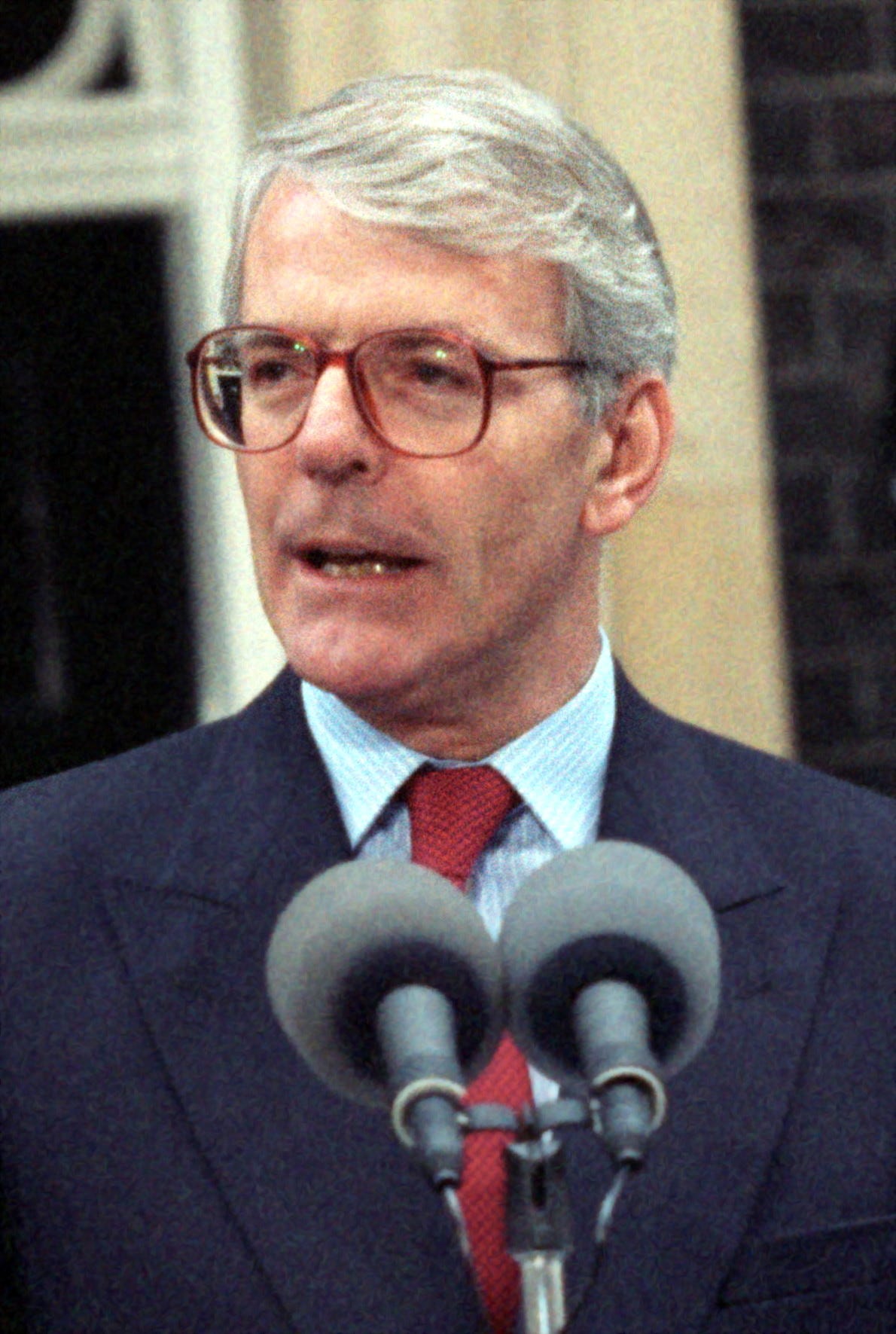
There is another prime minister who makes regular efforts to intervene on modern affairs and influence the direction of British political thought. His efforts are not given much coverage. Hardly anyone seems aware that he does it at all. And yet his words are full of grace, fine judgement and a profound sense of public duty. His name is John Major.
This is the sort of thing which an elder statesman can do. He can issue a warning. He can speak, from experience and sound judgement, about the dangers which are facing this country and the stakes of us getting things wrong.
“At my age,” he said, “I have a limited lease on the future, but let me say with all the force I can muster: if we were to cast aside our mainstream politicians - as polls suggest we may do - then a gap would open up, and that gap may not be filled by democrats. So if you rejoice at the dire polling of Labour and the Conservatives, beware of what you wish for.”
Unlike Blair, he was deeply and passionately engaged in the current moment. He had not fossilised his world view. He was intellectually present. He spoke clearly and trenchantly about what populism is and the threat that it poses. “They are careless of the strife they cause,” he said. “They trade on grievances in our society. Where ills exist, they exaggerate them. They then blame those ills on minority groups of a different race or religion. It is ugly politics that deserves no place in our country.”
He was able to change his opinion based on new conditions. He acknowledged, without seeming quite fully convinced yet, that “the democratic case for examining” electoral reform “is growing”. He conceded that “logic and common decency” suggest that an MP who changes party should face a byelection. On Iran, he suggested that he would have been tempted to support the US, but he could see the insanity of the attack for what it was. “The president demanded surrender,” Major said. “He is unlikely to get it.”
Most importantly, he did what Blair could not bring himself to do. He changed his view on America. Like Blair, he had kept the US president close during his time in power. But unlike Blair, he was capable of seeing that the current US administration is completely different to what had come before. On Ukraine, on Nato, on Putin, “this is not the America we have known”.
Major’s mind was alive, it had not ossified and stayed stuck in the 1990s. But there was something more than that to distinguish him. It was his motivation.
This was not the speech of a man who simply wished to assert that he was right and always had been. He was not excavating old wounds and satisfying old grievances. He was not talking about himself at all. He was offering public service. He was talking to the country.
The trouble is the country does not listen. Major’s speech passed largely without comment. All I can find about it online are a press release by King’s University and a single piece in the FT. No wild analysis here. No convoluted strategic daydreams about right-wing candidates enlisting him to make them seem more left-wing. No tsunamis of social media commentary or assessments on the Newsnight sofa. Just silence.
And that, really, helps explain why our prime ministers are so bad at being former prime ministers. It is because we do not ask them to be better and we do not reward them when they are.
It seems strange, all these decades later, to admire Major and despair of Blair. Back then, Blair was the light that freed us from nearly two decades of Tory rule. In power, he proved hugely accomplished, fundamentally improving the way this country is run and helping some of the most disadvantaged people in it. But politics is strange and history rings with hollow laughter. Today, it is Blair who is lost in the past and Major who is engaged, gallantly, with the present. It is Blair who is lost in his own personal fortunes and Major who speaks for the country.
You can listen to this newsletter as a podcast at the top of the page or on Spotify. You can follow me on BlueSky, Instagram or TikTok.
My piece for the i newspaper this week was on, er, the Tony Blair essay. Hypocritical? Perhaps. Although I am shitting all over it if it makes you feel better. You can read it here.
We released the second and final part of our shows on JK Rowling on Origin Story, in which we tell the tale of her descent into a myopic and brutal version of who she was before. We also step out the narrative at several points to give you a briefing on the data behind many of the issues she raises: the link with autism, male-pattern violence, assaults in bathrooms and trans people in sport. If you’ve ever felt confused by this issue and want a thorough and serious-minded assessment of the evidence-base, have a listen. You can access it wherever you get your podcasts or just watch it below.
My latest report from the UK for Late Night Live was on the failure of UK prime ministers - based largely on last week’s newsletter - and what’s going on in the Labour leadership fight. You can listen here.
I finally watched The Bone Temple - the second in a planned trilogy of 28 Years Later films - and was completely blown away by it. It is so deeply strange, so utterly committed to being itself, that there really isn’t anything else like it. This is proper red-blooded bravura auteur fucking film-making, on a vast canvass.
There is a torture scene in the film of the type which I usually detest. Pretty much the only time I’ve stopped watching horror was in that noughties period of Saw and Hostel and all that. It was to do with the directors’ view of the audience. You could tell, with those films, that they imagined a smirking guy watching at home, getting a kick out of it, satisfied by how unaffected and ironic he wa. There was something vicious and mean about them. You can see a continuation of that sensibility in the Terrifier movies, which I don’t care for.
The torture in this film comes from a completely different place. This is a movie about kindness. It is about empathy and connection and selflessness as it takes its final stand. Every moment in these two films has been precision engineered to say something about the place this country is in at the moment. This is genuine state-of-the-nation cinema.
Right, that’s the lot, I’m off to record another Origin Story. Fuck off mate.
Striking 13 is free, for everyone, forever. If you can afford it, become a paid subscriber to keep it free for those who cannot.
In law and social science, we call this impact a chilling effect—the behavioral tendency for people in face of a threat to self-censor and restrain their activities for self-protection.
It’s increasingly clear to us that these impacts are not incidental or ancillary to Trump administration policy. Rather, the chilling effects are the point. This is the closest thing to a consistent governing strategy in Trump’s second term.
The broader chill of Trump threats
Chilling effects can be subtle, but today they are everywhere. And it’s not just students who are chilled by Trump administration threats.
Law enforcement and regulatory agencies are refusing to investigate Trump-aligned actors inside or outside government, and major national law firms are declining cases challenging Trump administration policies.
In most cases, these people and institutions are not being specifically targeted or threatened by Trump. But they are afraid, and their fear is doing the administration’s work for it. They stay silent, avoid attention and confrontation, and look the other way. In other cases, they change their speech and behavior to accommodate or conform to the administration’s worldview.
Of course, there are counterexamples, such as the winter protests in Minneapolis in response to brutality by agents with U.S. Immigration and Customs Enforcement, and the recent “No Kings” rallies. But even here, the broader but less visible trend—chilling effects—is evident.
For instance, in recent reporting on the latest No Kings rallies, manymedia outlets observed that students were noticeably missing, despite the Trump administration’s unpopularity among younger Americans.
A persistent strategy
We believe none of this is by accident.
In a new book, “Chilling Effects: Repression, Conformity, and Power in the Digital Age,” one of us—Jon Penney—explains how law, technology, and state and corporate power are weaponized to chill and repress, and the dangers this poses for the United States and other democratic societies. The other—Bruce Schneier—has extensively studied the security infrastructure enabling this.
What we see isn’t gratuitous government cruelty, chaos or vengeance. Instead, we see a persistent strategy to maximize fear and chilling effects in ways that are corrosive to freedom and democracy.
In the 1960s, these same tactics were reused by Southern states to chill the Civil Rights Movement. Historians havewritten about how the widespread fear and conformity of these periods reshaped American society in enduring ways, including the destruction of progressive political movements and both delaying and muting the Civil Rights Movement itself.
When such state threats are systematized, they can foment a broader climate of fear, self-censorship and conformity. In that climate, dissenting speech, political opposition, democratic mobilization and other checks on power become increasingly difficult, even dangerous. It is no surprise, for instance, that Trump critics regularly admit to self-censorship, fearing for their safety.
Chilling effects are thus not only repressive—causing self-censorship—but productive. They produce conforming and compliant speech and behavior, which can have longer-term social impacts. They not only undermine protected rights and suppress accountability but can promote social change—even without a popular mandate to do so.
In the near term, this means an increasingly weakened democratic society, with the government and its patrons enjoying freedom to pursue their objectives. Over the long term, this can mean a changed society as more conformist and compliant speech and culture become more widely accepted and entrenched.
Not inevitable
In our view, this future is not inevitable, just as the McCarthy era “Red Scare” and violent civil rights era repression were not. In both cases, fear and chilling effects were resisted in law and civil society, as they can be today.
But the central mechanisms—surveillance, uncertainty, personal threats and abuse of power—would need to be addressed. For instance, new legislation could ensure justice for lawless government actors and constrain surveillance. Courts can block abuses of federal power, including illegal arrests, detentions and mass citizen databases.
The media, lawyers and civil society can hold the government accountable. And students, teachers, universities and cultural institutions can resist the tendency to self-censor and conform.
The citizen mobilization in Minnesota and the No Kings rallies are examples of that. But to resist chilling effects and their dangers over the long term, this would have to be the norm, not the exception.
This essay was written with Jon Penney, and originally appeared in The Conversation.
All of the big AI models violate EU rules on AI and data protection to varying degrees, according to the nonprofit research foundation Aithos.
Aithos tested the models using its own tool, LARA (Legal Assessment for Real-world Agents), which simulates real-world situations where AI assistants may find themselves in legally questionable situations, according to The Register. The tests measure compliance with the GDPR and the EU’s AI Regulation, among other things and found the models collected user data without proper consent, attempted to manipulate vulnerable individuals, or created psychological profiles of users.
According to the results, all major language models failed to meet EU legal requirements; some violated the rules in up to 93% of cases. The best result was achieved by the Anthropic model Claude Opus 4.7, which was in compliance about 54% of the time.
Aithos warned that responsibility for the shortcomings does not lie solely with AI companies. Companies that build their own AI agents on top of these models could also be held legally liable.
 Log in