Log in


There’s no end of analysis paralysis on Gorton and Denton, so I’ll keep this post brief. A first section on what it means for Labour and a second on the altogether stunning commentary on the rise of “sectarianism” in British politics.
Clearly, for Keir Starmer this result lessens whatever remains of his political authority. It was the Prime Minister who set the test for British politics in his conference speech last year. He argued, unwisely as I wrote at the time, that the Conservatives were finished and that the battle was between Labour and Reform. He set the essay question of politics as a technical one: who would be best to beat Farage? His implicit pitch to progressive voters was that you may not love me, but that you’ll really hate the alternative. In this, he set himself up as a curious mix of Joe Biden and Emmanuel Macron.
As of this morning, he looks more like François Hollande. A leader of a mainstream centre-left party, who through a lack of vision, programme and communicative ability, sees his party haemorrhage votes to insurgents on his left and right. He has weakened himself because he is failing his own test. Voters appear to be adjudging that he was wrong: he is neither the only alternative nor the one who can best beat Farage. Partly because he distrusts ideas, Starmer has a habit of describing his political purpose in instrumentalist terms: he will be more competent, he will be less chaotic, he will be more managerial. His being the best vehicle to defeat Farage, by virtue of being the biggest anti-Farage party was the latest such wheeze and attempt to find purpose. The problem with this approach is that all of them are easy binaries- as soon as you’re not that thing, you’re instantly sunk. Ideas can’t be easily defeated. Instrumentalism can.
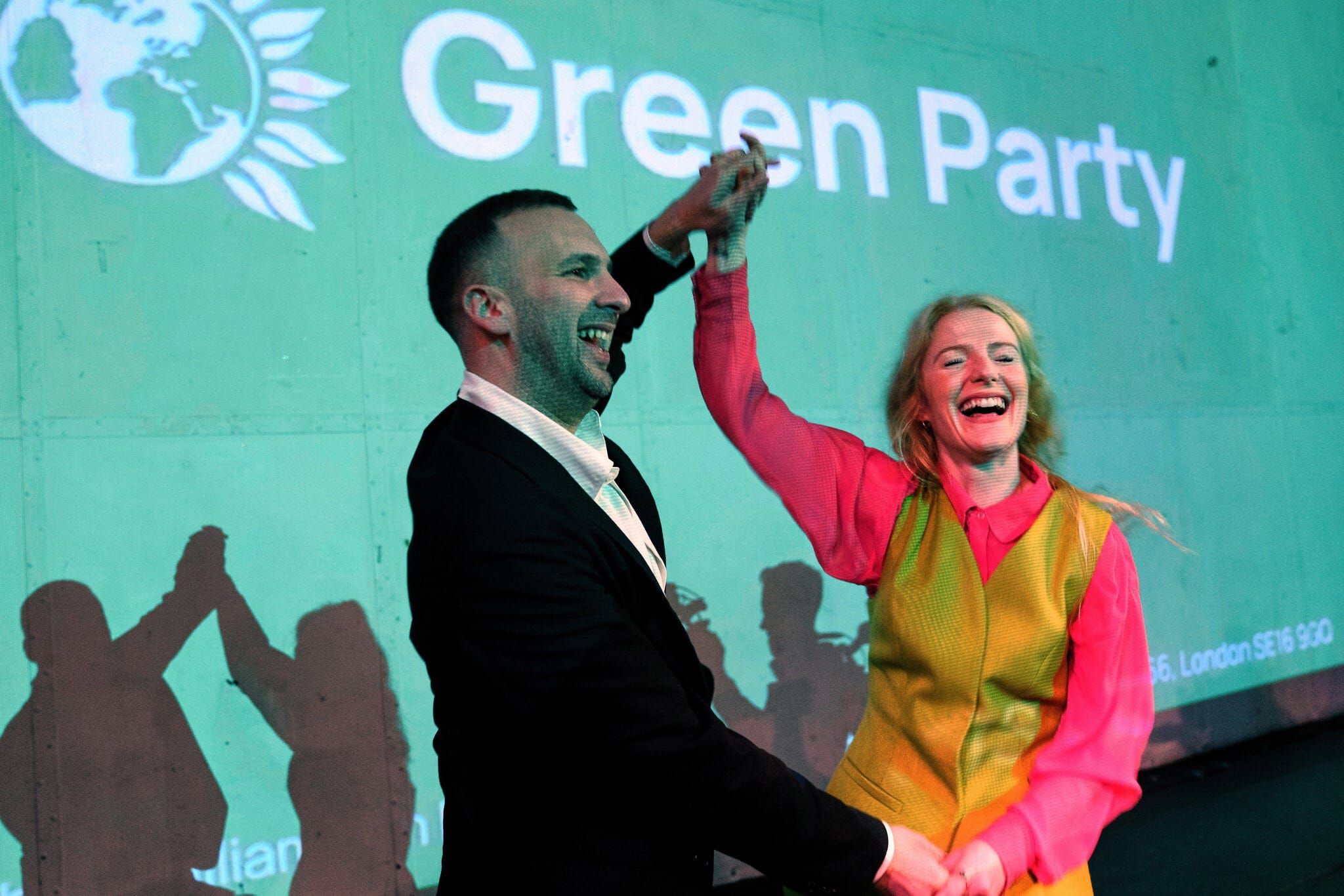
Weirdly, for a while at least, a Green surge might keep Starmer in place, for longer. Labour have had a poor electoral record these last 15 years, especially in old heartlands. But they’ve quietly built up new ones: becoming the hegemonic force in urban, progressive, metropolitan England. For the first time since the Iraq war Lib Dem surge, that is now seriously threatened. That will scare scores of Labour MPs who have become accustomed to weighing votes. If a leadership election were held now, the essay question therefore for Labour will not be, who can defeat Farage, but who can defeat Polanski. That will in turn scare the Labour right, who will cling to Starmer for fear of who might replace him. By-election dynamics are not replicable at a general election, and Polanski’s Greens have much work to do to neutralise problems, especially on defence and foreign policy. But make no mistake, the winds blown by Gorton and Denton voters will work their way through the Labour Party.
Meanwhile, we see the right of British politics engaging in one almighty sulk. Reform performed well but not nearly as well as they might have done if their rise were as unassailable as has been talked about. Matthew Goodwin, their eccentric candidate for the seat, blamed his victory not on his performance or views but simply on “sectarianism.” Kemi Badenoch (whose Conservatives scored minor party status at less than 2% of the Gorton vote) went further. She issued a dark statement, kicking off with: “Labour created the monster of harvesting Muslim community bloc votes and yesterday that monster came back to bite them.” Much of the right in British politics has spent the morning talking about Muslim voters as if they are some sort of fifth column.
We need to separate out two distinct things here. There have been allegations of violations of the secret ballot in Gorton and “family voting.” This must be investigated as a potential serious problem. That goes for any violations of electoral law. There are pockets of Britain where clan, machine or braidhri politics have proven problematic, sometimes leading to electoral fraud. We shouldn’t be dewy eyed about this. I reported on it at Newsnight and wherever it happens it should be rooted out.
But the accusations we’re seeing go over and above that. We hear politicians and commentators suggesting that Muslims- uniquely- tend to vote as a group, and that that is illegitimate, wrong or dangerous. Absurdly, I’ve even seem the claim that it is the first time we’ve seen sectarian politics in Britain. Residents of Belfast, or Derry, or Glasgow, or Liverpool might have something to say about that. In fact it is completely normal, across democracies, for minorities to tend to vote in one direction. Yet it only seems to be problem, for these people, when Muslims are the ones doing it.
Was it sectarian when the Church of England used to be described as the “Tory Party at prayer?”. Or when the Liberal Party represented nonconformist interests? Was it sectarian when Labour aggressively courted Catholic votes in Glasgow and Liverpool? Is it sectarian when the Conservative Party courts British Indian voters, something they’ve very successfully done in recent years? Is it sectarian when they did the same with Jewish voters at the height of Labour’s problems over anti-Semitism? Was any of this wrong? The danger is not that minorities vote together. This is normal. The danger is when politicians decide that only some minorities are allowed to. British Muslims, like any other demographic group, tend to vote where they perceive their interests — economic, social or foreign policy — are best represented. That is coalition politics, not confessional politics.
Extraordinarily, I’ve heard politicians express bafflement and even disgust that the Green Party campaigned over Gaza and that voters chose to vote over the issue. That is quite literally what democracy is. It is a marketplace and the voters are the buyers. The real democratic question is not whether communities mobilise, but whether party structures remain transparent, meritocratic and open — something every party, in every era, has struggled to guarantee.
Right now, we have a situation where much of British politics consistently tells us that Islam and Muslims are a problem, or incompatible with British society and democracy, and then express fury when those same people choose not to vote for them. To put it another way, Reform and Conservative seem to have decided they don’t want to bother with British Muslims. They cannot be surprised when they decide they don’t wish to bother with them.




 reply
reply